Search This Blog

Saturday, 15 May 2021

Halifax LW579, 51 Sqn, RAF Snaith , Cowleaze wood, Chilterns ,Oxfordshire 30th March 1944 Nuremburg raid

From MY last trip to Oxfordshire.

Halifax LW579, MH-V, 51Sqn RAF Snaith, Yorkshire took off along with 795 other planes from all over England on a raid to Nuremburg, Germany. This night was to mark the worst night for Bomber Command in WW2, 97 planes were lost to defences and night fighters, 9 more were written off in accidents or damaged beyond repair, 6 of 51 Sqn aircraft were lost, this raid cost the lives of 545 airmen.


LW579 survived to mission over Nuremburg and made it back over England but though a clear night with a bombers moon, the strong winds which had broke up the attacking aircraft and hampered accuracy over Germany may now have pushed LW579 away from its course home by 120 miles. Flying his plane over blacked out Oxfordshire the pilot P/o James Brooks started to descend, the lost bomber may have been trying to get to RAF Benson which was nearby, but maybe not being aware of the dark mass of the Chilterns that lay between his plane and the safety of Bensons runway, sadly hitting the trees of Cowleaze Woods the Halifax broke up and sadly all 7 crew were lost.  


Today a marked trail leads from the sign board in the carpark winding through the trees to a large sandstone plinth marking the crash site, the stone was brought from Lincoln Cathedral and inscribed with the crews’ names. Nearby a shallow scrape marks the site of the bombers crash and a dig that was carried out to recover remains from the site, though I have no details as to when or who carried out the dig.


Looking about the memorial I did find some small remains on the surface near the path, given the high volume of passers-by I was surprised anything would be still visible. In the 30mins I was there 2 groups of walkers came up and were fascinated by the finds and story, one group told of their grandfathers service in Spitfires in WW2 and as if history has a sense of timing a Mk 9 trundled overhead.


 Crew of LW579 =

P/o J.  Brooks

F/s D.J.McCormack

Sgt T.S.Connell

Sgt R.Kelly

F/s D.A.Churchill

F/s G.W.West

F/s S.Glass

Saturday, 8 May 2021

Winslow 7th August 1943,Wellington X3790 Mk III of 26 Operational Training Unit RAF Little Horwood

3am on the 7th August 1943 in the small town of Winslow, Oxfordshire, many slept quietly as a lone plane circled overhead, the crew struggling to line up for a second attempt to land at nearby RAF Little Horwood.
Wellington X3790 Mk III of 26 Operational Training Unit had taken off on a training bombing mission but had to turn back after the bomb sight failed to operate correctly. Flying over blacked out country the pilot tried the get down but had to go around, in the rear of the bomber Sgt Navigator Jeffrey Harrington had his work cut out watching his instrument's, next thing he remembered was waking up next to the burning remains of his plane.


The plane flying very low had impacted a tree and tore off a wing, uncontrollable, the Wellington crashed through the Chandos Arms pub, careered across High street and into the 4 Rose cottages destroying one, of the 5 crew, 4 were lost in the crash but tragically many more died on the ground.
13 civillians died in the town including Thomas Cox, landlord of the Chandos Arms, Tom Paintin of number 82 High Street also his son Donald, Stephen and Doris Mullis and their 2 children Terence and Kathleen, Israel and Annie Goldberg their daughter Lottie Hoberman and her son Victor [evacuees from Stoke Newington], also William and Nora Hawkins.
X3790s crew lost
Sgt Pilot Wilfred Davies
Sgt (Jock) McKeon
Sgt John Sowter
Sgt Clive Fietz
Sgt Navigator Jeffrey Harrington survived.
On the street today nothing shows of this sad accident but the gap in the frontages. Nearby at the British Legion hall a memorial plaque has been built into the outside wall a small reminder of an awful night in Winslow


Sunday, 25 April 2021

Halifax NP681, OW-J Linton-on-Ouse 426 Sqn R.C.A.F . Wallingford Oxfordshire 9th September 1944

9th September , 1944 allied forces were besieging Le Harve to help support this Bomber command sent a force of Heavies to blast the defenders one of these planes was Halifax NP681, OW-J flying from Linton-on-Ouse the plane and crew were part of 426 Sqn R.C.A.F .

Taking off in the early morning the flight was uneventful until over the target but due to cloud the the planes turned home NP681 was unlucky to have run into what little flack that was put up and reported some damage and attempting to jettison the bomb load of 16 x 500lbs over the channel but only 4 were left at the bottom of the water 12 hung up, later over Reading the port outer exploded into flames the pilot F/o J.A.Wilding ordered his crew to leave the stricken plane 5 successfully bailed as Wilding and the flight engineer Sgt J.F.Andrew struggled to control the bomber as the last man jumped the port wing disintegrated sending the bomber into a dive hitting open fields near Newnham Murren where the remaining bombs detonated both F/o Wilding and Sgt Andrew were lost .

On the 21st May 1960 locals erected a cairn and plaque commemorating the 2 crew whose sacrifice saved many on the ground and the 5 crew 2 the cairn stands at the junction of 2 roads named in Wildings and Andrews honour .


Saturday, 17 April 2021

Typhoon DN444 22nd March 1943 Sgt Quentin MacPhail 'Mac' Shippee.247 Sqn Brookside Telford

In the quiet road of Bishopdale, Brookside, Telford nothing today shows of the sad loss of a Typhoon Ib and its young Canadian pilot.
22nd of March, 1943 R.A.F High Ercall 4 pilots boarded their 247 Sqn [China-British] Typhoon Ib’s which had been sent from R.A.F Middle Wallop on 30hr inspections. The pilots were P/O Herbert Langree Van Zuilecom, Sgt William Leslie Wheeler, P/O Aitchison and Sgt Quentin MacPhail 'Mac' Shippee.


Spending the morning sorting flight plans and checking the weather as one plane was still not ready, the flight leader P/O Zuilecom, decided that the planes would take off at 16.00 hrs as the weather seemed ok though marginal with haze and low cloud. Leaving the ground the 4 Typhoons formed up and set course but almost immediately the flight flew into worsening conditions, unable to maintain formation 2 of the big fighter bombers flew back to High Ercall and the leader made it as far as R.A.F Defford, Worcestershire.
One of the Typhoons, DN444 Piloted by Sgt Shippee was not seen by the other pilots after take off ,not long after the flight broke up Sgt Shippee was over Windmill Farm, Madeley. A young boy near the railway in Madeley heard the plane overhead and noted its engine noise was erratic, looking skyward he saw a large shape break the mist only 15 ft above the ground and at high speed the plane crashed and was totally destroyed, Sgt Shippee did not survive the crash.
Sgt Sgt Quentin MacPhail 'Mac' Shippee was buried in St Cuthberts Church , Donington , Albrighton


Friday, 9 April 2021

Oxford W6648 11 [P]AFU , RAF Shawbury ,29th of December 1943 Pilot Officer Gerald Obenauf Dawson

A quick trip out to find a few local sites with Tricia .
Oxford W6648 11 [P]AFU took off from RAF Shawbury on the morning of the 29th of December 1943 for a training flight to the west of the Wrekin the young Pilot Officer Gerald Obenauf Dawson was to practice climbing turns , stalls and single engine flying , at about 10.45 am the Oxford was over Cressage, Shropshire and was seen to be slowing into a stall but sadly the young pilot misjudged the height available as the plane dropped out of the stall into a spin the pilot tried to recover but with no time left the plane crashed on the slopes of Harnage woods killing P/o Dawson .


In the wood today all that shows is a break in the trees and disturbed growth on the slope as the woods are private I only took photos and left
P/o Dawson is buried at Blancon Cemetery Chester .


Friday, 2 April 2021

Do335-12 [RP+UB] 240112, Cove Junior School , Hampshire ,12th January 1946 , RAE Farnborough

A work trip to the south to Cove gave me the chance to visit the crash site of a very unusual plane.
At the end of fighting in WW2 Europe, allied forces had been finding many weapons and technology and set about evaluating them and seeing what they could learn. One such weapon was the Do335 a push puller type of aircraft only a very few were captured by American forces in the factory was a Do335-12 trainer [RP+UB] 240112, this plane was to have gone to the US but British Intelligence worked a deal for 10 FW190's and the plane was picked up and flown to RAE [Royal Aircraft Establishment] Farnborough, Hampshire in September 44 for test flying.
At 11.30am 12th January 1946 the now recoded AM223 Do335 taxied out for its 3rd flight since its arrival, at the controls was the commanding officer of Farnboroughs Experimental Flying, Group Captain Alan Frederick Hards,DSO. The plane took off watched by test pilot Captain Eric 'Winkle' Brown who had trained Group Cpt Hards on the 335 and this was Hards first solo.
Half an hour later Brown saw the plane returning to the base but he also saw it was trailing smoke from below the rear engine, it is unknown if Hards knew of the fire as it would have been next to impossible for him to have seen anything of the rear of the plane. Hards entered the circuit and turned for the duty runway but sadly the fire must have burnt through the tail controls as the aircraft dropped suddenly, impacting a field behind Cove Junior School bouncing and hitting the headmasters house and damaging the school buildings, thankfully only 12 on the ground were injured as the school on that day had 300 children in classes and they were just about to break for lunch. The Do335 was completely destroyed and Group Captain Hards was found in the upper bedroom beyond help he was recovered and taken back to RAE Farnborough.


 At the site today the school still stands and still serves the local juniors, the headmasters house was demolished after the crash and nothing can be seen to remind anyone of a sad but also very lucky day

Saturday, 13 February 2021

Hudson T9320 1,OTU RAF Siloth, Cumbria Eastleigh Hampshire 15th August 1940

On a work trip to the south I managed to find a few minutes to look for the site of the loss of a No.1 OTU Hudson.
Hudson T9320 from 1OTU RAF Siloth, Cumbria was sat waiting to take off from RAF Eastleigh, Hampshire on the afternoon of the 15th of August 1940. The plane with 9 on board 8 of whom RAF and one civilian from the Sperry Company, was to fly back to Siloth via RAF Northolt and return with crew who had been ferrying another aircraft to Eastleigh.
The pilot, talking with a civilian and the Air Watch Officer was told that it was not advisable to leave as an air raid was expected and a ‘Yellow’ state of warning was in effect, the pilot anxious to get away before the raid started decided to go and the Hudson taxied out.
Lifting off the pilot climbed the Hudson to 700ft but tragically ahead the 924th Balloon Squadron had just finished raising the barrage balloons to their operational height . T9320 struck one of the cables which severely damaged the plane and falling almost immediately, the Hudson impacted No 199 and 197 Nutbeem Road, Eastleigh destroying both houses and the plane. All on board were lost and sadly a large part of the plane fell onto No 195, this took the lives of the two occupants Thomas & Ellen Craig.

On the street today nothing shows to tell of this accident the houses were rebuilt and all traces long gone.


 Those on board T9320=

S/Ldr W.G.A.Coulson
F/O R.H.Immelman
P/O A.P.Davis
P/O B.N.Whittle
Sgt A.M.Froud
Sgt D.B.Cowie
Sgt J.Barlow
AC2 A.Taylor
Mr J.S.Whittaker [ Sperry Representative]

Sunday, 31 January 2021

P-47c 41-6231 25th june 1944 551st FTS 495th FG, Atcham St Ediths church , Church Pulverbatch Shropshire

Next to St. Ediths Church in Church Pulverbatch is a memorial to Lt Arthur. D. Brody USAAF who lost his life in a field that the memorial overlooks.
At 6.30 pm on the 25th of June 1944, 4 P-47C Thunderbolts all from 551st FTS 495th FG, Atcham were on a practice flight over Shropshire. Climbing the fighters flew in formation until they were bounced by another flight, breaking formation the planes chased each other losing height until the fur ball broke up and the fighters tried to find their squadron mates.
One P-47 41-6231 coded DQ-B was seen by St Ediths congregation to be performing some aerobatics over the village, the fighter then passed low over the church and dipped towards the fields below but unseen by the pilot until the last second, a large tree was in his path. The fighter clipped the tree then cartwheeled and exploded scattering remains over a large area.

Locals had told a very helpful lady I met at the church, that young pilots from Atcham including Lt Brody, had been at a party the night before at Wrentnall House nearby, it was thought Lt Brody was putting on a bit of a show for his hosts.


 Lt Brody is Buried in Cambridge Madingley cemetery

Sunday, 24 January 2021

P-38J 42-67701 RAF Atcham, 2 Lt Alan. Stewart. Green 16Th September Lyth Hill Shrewsbury

RAF Atcham, Station 342 , Shropshire a USAAF fighter Training base used mainly Spitfires and P-47s but also had a few P-38s one was lost in a quiet field not many miles from the base and I visited the site last year.


42-67701 Code DQ-Q a P38J flying with the 552nd FTS, 495th FTG lifted off on the afternoon of the 16 September 1944 for a local training flight. At the controls young pilot 2 Lt. A.S.Green, his mission was to take place in the company of another P38 piloted by Sqn fellow 2 Lt. J.W.Mahoney.

The flight went without any problems and the pilots set for home, nearing Bayston Hill just south of Shrewsbury Lt Green’s starboard engine cut out, Contacting his wingman by radio to inform him of his problem an instructor also on the same frequency advised 2 Lt. Green to climb before attempting to attempt a restart, but as the young pilot pulled the fighters nose up his other engine shut down and at only 2,000ft 2 Lt. Green had no choice but to force land ahead.


The now silent fighter headed for a field at Lyth Hill but sadly the field has a sharp rise up to a hedge, the p38 hit the rise and stopped instantly, the force broke the pilot’s seat loose and 2 Lt Green hit the instrument Panel and sadly lost his life.


A inquiry came to the conclusion the 2 Lt Green had mistakenly left his fuel cross feed drawing off the planes empty tank, not switching to the tank with fuel in it. Given the high workload the young man was under in formation flying in this challenging but excellent fighter, it is all too easy for a momentary error to become a major problem.


2 Lt Alan. Stewart. Green is buried at the US cemetery Madingley , Cambridge 


 2 Lt Alan. Stewart. Green is buried at the US cemetery Madingley , Cambridge 

Saturday, 16 January 2021

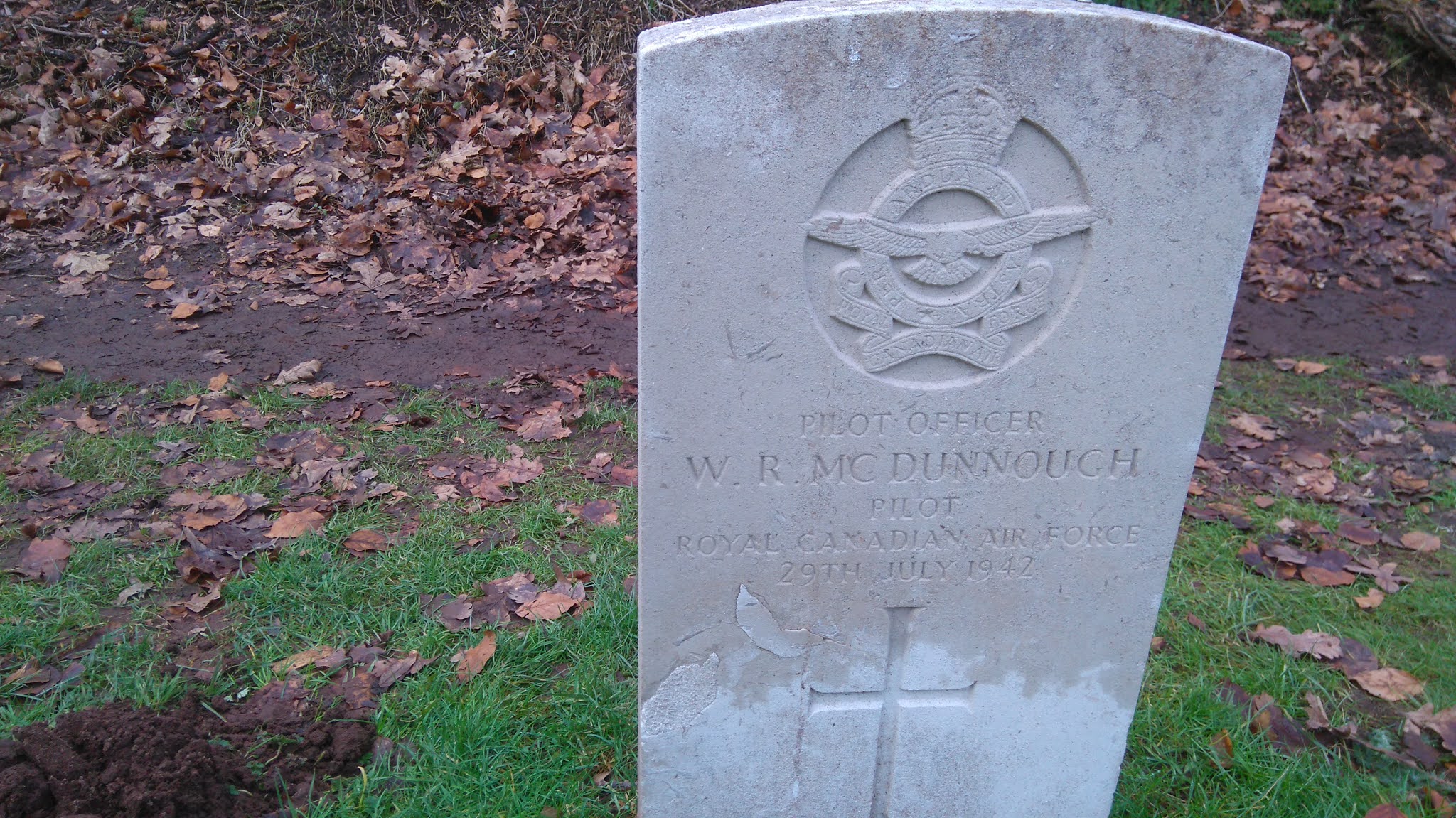
Typhoon R8633 29th July 1942 Sugdon , Shropshire F/O Willian .McDunnough RCAF RAF High Ercall


A muddy walk with Tricia to follow the last moments of the fight of Hawker Typhoon Ib R8633.
257 Sqn High Ercall, Shropshire were just starting their conversion from the Hawker Hurricane onto the new and impressive Typhoon but it was a conversion to a plane with an unknown fatal fault later resolved to make it one of the best ground attack aircraft of WW2.
R8633 took off on the warm afternoon of 29thJuly 1942 the pilot F/O Willian .McDunnough RCAF was to take the plane on a local aerobatics flight, just before 16.45pm a local school boy watched an aircraft dive suddenly. The tail broke off at the rear of the fuselage and the Typhoon snapped onto its back falling at high speed into the ground near the small hamlet of Sugdon, the remains of the tail fell nearly a mile away by Isombridge , later investigations came to the conclusion that the planes port elevator detached causing the loss of the tail .


Sadly F/o McDunnough a popular and good pilot lost his life in the crash and was buried within sight of the crash at High Ercall’s St Michael and All Angels church.
Today a pleasant 2 mile walk passes the field where the main part of the plane fell which is now under a Beet crop, and then on to where the tail impacted. Though nothing shows of this loss on the ground, in the church you can find McDunnoughs grave next to 2 other RAF Graves in a quiet corner

Thursday, 31 December 2020

Ablemarle V1609 ,Hartford,Cheshire, 15 april 1944 42 OTU RAF Ashborne


A drive out to Cheshire to find 2 sites.
In the warm days of April 1944 the pace of training was accelerating across England for D Day. Ablemarle aircraft of 42 OTU RAF Ashbourne, Derbyshire were to play a key part in operation 'TONGA ' the air dropping of the 6th airborne over Normandy.
Ablemarle Mk2 V1609 took off with its crew of 5 on a training flight to RAF Tilstock Shropshire. Climbing into the sunny day the crew set course, but some time later in the small village of Hartford locals heard the approach of a plane. This plane grew closer and passed over Chester Road it then began a turn to pass over again this time lower. V1609 turned and dropped lower, but on this pass the crews luck ran out clipping the chimney of a cottage in a row called 'The Villas', the damaged plane fell and crashed across the road into a wall and broke up over farm land on Grange Farm behind the wall.


The rear turret was thrown onto the road with its injured occupant trapped inside, locals ran to help but sadly only the Gunner was saved from the crew of 5.
On the street today nothing shows but a small plaque placed on the wall next to the crash site, this happened after local objections to a housing development on the site and fears that these young men would never be remembered after the area was put under tarmac.
Across the road the villas still stand and if you look carefully you can see the rebuilt chimney on the end of the row. One of the crew lost, Sgt Aubrey Graham Crowe, lived a few doors down from this house and it is likely the crew fell into a all too common trap of performing high jinks over a family home as they were 50 miles off the intended track.
Sgt Crowe rests in a family plot in St Johns church overlooking the crash site.
Crew lost in V1609 =
F/Sgt R.P.H.Brown
W/o F.A.Andrew
F/Sgt A.G.Crowe
F/Sgt J.Crichton
Survived =
Sgt A.Ewen


Friday, 25 December 2020

Spitfires P7304 and P7444 collision, 22nd August 1943 60 OTU RAF Rednal, Hincks Plantation Telford

22ND August  1943 two 60 OTU Mk2A  Spitfires sat waiting for their young pilots at RAF Rednal, Shropshire. The pilots both Belgian exiles Sgt J.J.Albert  and P/o H.M.Goldsmit  who were training to fight on for the UK, boarded the Spitfires and taxied out on a combat training mission over Shropshire. The pilots commenced a turning fight near Newport and during this the aircraft P7304 [Albert] and P7444[Goldsmit] collided, P7304 went out of control diving into soft ground at Hinks Plantation not far from Donnington , Telford with the sad loss of the pilot Sgt Albert, P7444 limped away.  There is some debate where  P/o Goldsmit made for to land his damaged plane, but as RAF High Ercall is very close seems it would have been a  good place to get down ASAP .


In 1977 WARG [Wartime aircraft recovery group ] carried out a dig at the site and found many remains including the battered engine, these are now on show in the fantastic museum on Sleap Airfield near Shrewsbury. Also on the access road at the old RAF Rednal  a memorial to Sgt J.J.Albert  is visible in a small fenced area .


I cannot say whether the Spitfire model in a garden near Hinks Plantation is to do with this loss, the codes are not of P7304 and I couldn’t find the owner to ask but I like to think it’s a fitting reminder.